
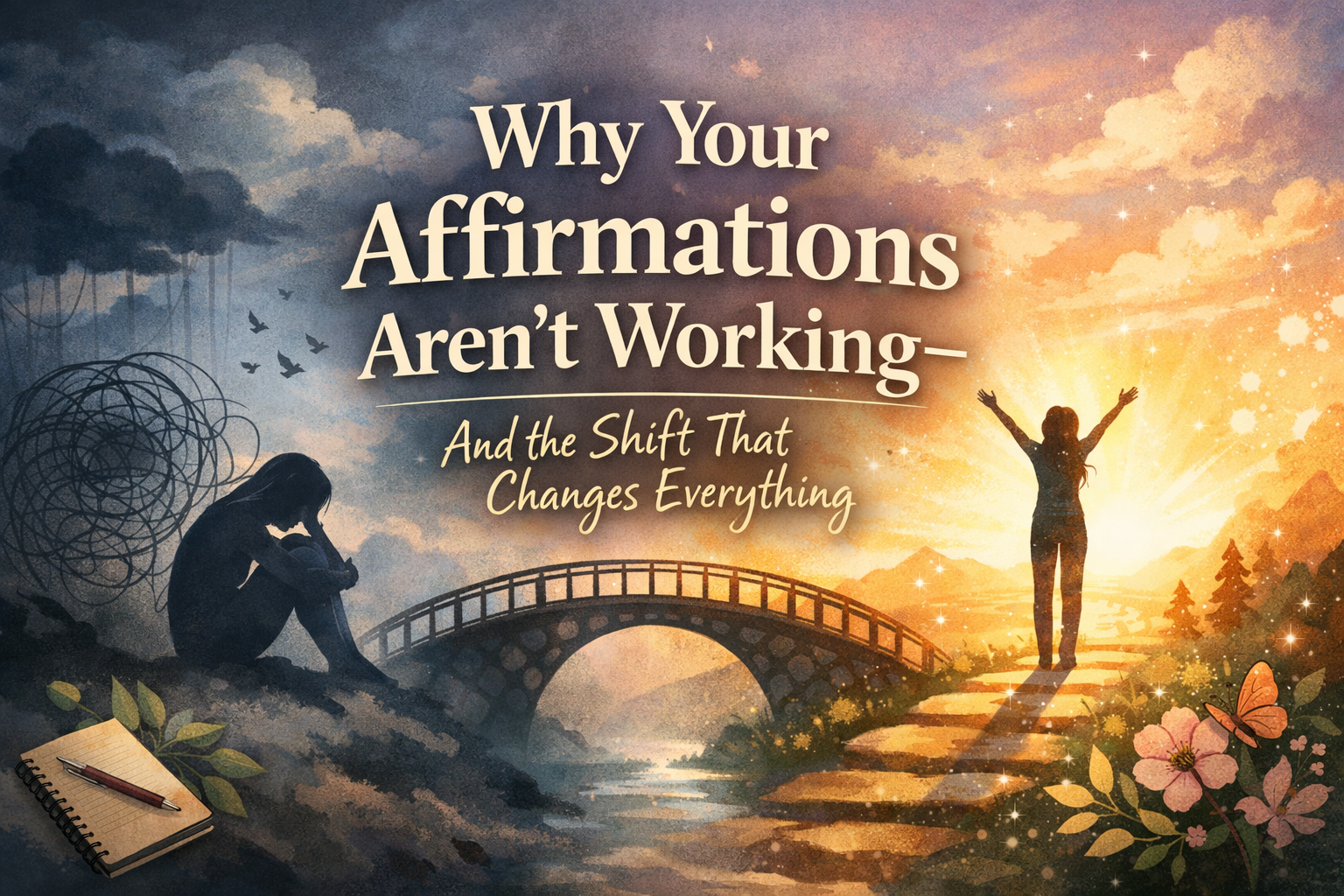
Why Your Affirmations Aren’t Working is a question many people quietly ask themselves after repeating affirmations daily and still seeing no real change. If you’ve ever wondered whether affirmations actually work, you’re not alone. This frustration is common, especially when you’re doing “everything right” but nothing seems to shift. That feeling is exactly why the topic why your affirmations aren’t working deserves a deeper, more honest explanation—one that goes beyond surface-level advice and into what’s really happening beneath the words.
Table of Contents
ToggleRepeating From a Grounded State
Repetition is only effective when it’s coming from calm. This is one of the most overlooked aspects of affirmation work and a major reason why your affirmations aren’t working, even when the words themselves are well chosen.
When you repeat an affirmation while tense, rushed, or emotionally activated, you’re reinforcing the very state you’re trying to shift. The body remembers the tension more than it remembers the words.
On the other hand, repeating an affirmation from a grounded state reinforces safety. The nervous system associates the affirmation with calm rather than pressure. Over time, this creates familiarity instead of resistance.
This is how affirmations shift from something you say into something you become familiar with.
Familiarity is powerful. When something feels familiar, the body stops resisting it. When resistance drops, beliefs begin to form naturally.
When affirmations follow the correct order—regulation first, then gentle repetition—they stop feeling forced and start feeling supportive. Over time, this sequencing removes the confusion around why your affirmations aren’t working and replaces it with a practice that feels steady, sustainable, and real.
Regulation Before Affirmation (Simple Practice)
You don’t need a long ritual to regulate your nervous system before affirmations. What matters is signaling safety to the body before introducing new beliefs.
Before you begin affirmations, try this simple practice:
-
Take three slow breaths
-
Place one hand on your chest
-
Exhale longer than you inhale
This activates the parasympathetic nervous system, which tells the body it’s safe to relax. When the body relaxes, receptivity opens.
Think of regulation as preparing the soil before planting a seed. Affirmations planted into tension struggle to grow. Affirmations planted into calm take root more easily.
Even thirty seconds of regulation can completely change how affirmations feel and how well they integrate.
Examples of Affirmations That Actually Work
Affirmations that work well share one key quality: they meet the body where it is instead of demanding it leap ahead.
Confidence
-
“I’m allowed to build confidence at my own pace.”
-
“I feel safer showing up as myself.”
These affirmations don’t deny fear or insecurity. They acknowledge growth as a process rather than a demand.
Abundance
-
“I’m learning to trust my ability to receive.”
-
“I am open to small signs of support.”
Instead of forcing a belief in abundance, these statements gently expand the nervous system’s tolerance for receiving.
Healing
-
“My body responds to gentleness.”
-
“I’m allowed to heal without rushing.”
Healing-based affirmations work best when they remove pressure. Gentleness signals safety, which allows the body to participate instead of resist.
Each of these affirmations works because it respects the current emotional state while still introducing movement forward.
Why Emotional Honesty Multiplies Results
Pretending you’re fine when you’re not is another common reason why your affirmations aren’t working.
Affirmations are not meant to erase emotions. They are meant to support you through them.
When affirmations deny what you’re actually feeling, the nervous system tightens. When affirmations acknowledge truth, the system relaxes.
This is why affirmations work best when paired with emotional honesty.
For example, instead of saying:
-
“I’m not afraid.”
Try:
-
“I can feel fear and still move forward safely.”
This subtle shift removes internal resistance. It builds trust between your conscious intention and your emotional experience.
Honesty creates alignment. Alignment creates safety. Safety creates change.
When affirmations are honest, they stop feeling like something you’re forcing yourself to believe and start feeling like something you’re genuinely growing into.
These sections are doing exactly what they need to do:
They teach, normalize resistance, and guide the reader back into self-trust.
Safety Always Comes Before Belief
Here’s a key truth that changes everything about manifestation, affirmations, and personal growth:
Your nervous system must feel safe before it allows new beliefs to take root.
Belief doesn’t come first.
Regulation does.
This is where many people get stuck without realizing it. They try to think their way into change before their body feels ready to receive it. When that happens, affirmations sound good on the surface but feel empty underneath.
When the body feels unsafe—emotionally or physically—even the most beautifully worded affirmations will feel hollow. They won’t land. They won’t integrate. And over time, they can even create frustration or self-doubt.
On the other hand, when the body feels grounded and supported, even the simplest, gentlest affirmations can create meaningful and lasting shifts.
This is a foundational reason why your affirmations aren’t working when safety is skipped.
Why the Body Decides Before the Mind
The nervous system evolved long before conscious thought. Its job is not to evaluate ideas—it’s to ensure survival. That means it responds first and fastest.
If an affirmation suggests a new identity, possibility, or outcome that feels threatening to your current sense of stability, the body reacts by tightening, numbing, or disengaging. The mind may want the change, but the body hasn’t agreed yet.
Until the body feels safe, belief cannot stick.
This is why forcing affirmations often leads to inconsistency. The system isn’t resisting growth—it’s protecting you from perceived overwhelm.
Grounded Affirmations Create Faster Results
There’s a paradox many people don’t expect:
Affirmations that feel small, realistic, or understated often work better than bold declarations.
Why?
Because they don’t shock the nervous system.
They don’t demand immediate identity shifts.
They don’t create internal conflict.
Instead, they invite the system forward gently.
For example:
-
“I am open to feeling a little more confident today.”
-
“It’s safe for me to explore new possibilities.”
-
“I can take this one step at a time.”
These affirmations may seem modest, but they build trust. And trust is what allows belief to grow organically.
Safety Is Not Settling — It’s Strategy
Choosing safety-based affirmations doesn’t mean lowering your standards or giving up on your goals. It means honoring the order in which change actually happens.
Safety creates receptivity.
Receptivity creates consistency.
Consistency creates transformation.
When affirmations feel supportive instead of demanding, your system relaxes. When it relaxes, repetition happens naturally. And when repetition is natural, beliefs begin to shift without force.
This is how affirmations stop feeling like work and start feeling like alignment.
A Simple Way to Check for Safety
Before committing to an affirmation, ask:
-
Does this feel calming or tense?
-
Can I breathe easily while saying this?
-
Does my body feel open or resistant?
If resistance appears, that’s not a failure. It’s information. Adjust the affirmation until it feels like an invitation rather than a command.
That small adjustment is often the turning point between struggling with affirmations and finally understanding why your affirmations aren’t working.
When safety leads, belief follows naturally.
And when belief follows safety, change becomes sustainable instead of forced.
The truth is not that affirmations are ineffective. The real issue is how they’re being used, when they’re being used, and what state you’re in while saying them.
Affirmations are not magic words that override your inner world. They are a relationship-building tool between your conscious intentions and your emotional body. When that relationship is missing, affirmations feel empty, forced, or even irritating.
This post will gently but clearly explain why your affirmations aren’t working, what’s actually happening beneath the surface, and the one foundational shift that changes everything.
Why Your Affirmations Aren’t Working: The Real Reason Most People Miss
One of the biggest misunderstandings around affirmations is the belief that repetition alone creates change. Many people are taught that if they simply repeat a statement often enough, the mind will eventually accept it as truth.
This idea sounds logical, but it leaves out a critical piece of the process.
Here’s the uncomfortable truth most people never hear:
If your nervous system doesn’t feel safe with an affirmation, your mind will reject it—no matter how many times you repeat it.
This is the core reason why your affirmations aren’t working.
Affirmations don’t fail because you didn’t say them enough times. They fail because they bypass the emotional and physical experience you’re having in the moment.
Why Logic Alone Doesn’t Create Change
Your subconscious mind isn’t persuaded by logic, motivation, or positive thinking. It’s influenced by felt experience—what your body believes is happening based on emotional patterns, memory, and nervous system responses.
When an affirmation directly contradicts how you experience yourself or your life emotionally, the body resists. This resistance isn’t conscious, and it’s not personal. It’s protective.
Your system is essentially saying:
“This statement doesn’t match my lived experience yet.”
That mismatch creates tension instead of transformation.
What Resistance Looks Like in Everyday Affirmations
Here are some common examples of affirmations that are often repeated with good intentions—but poor emotional timing:
-
Saying “I am confident” while your body feels tense, guarded, or small
-
Saying “I am abundant” while you’re actively stressed about bills or income
-
Saying “I trust the process” while your nervous system is in survival mode
-
Saying “I am calm” while your body feels restless or overwhelmed
In each case, the affirmation itself isn’t wrong. The issue is that the statement asks the body to jump to a reality it doesn’t yet feel safe inhabiting.
This disconnect is one of the most common reasons why your affirmations aren’t working, even when you’re committed and consistent.
What Actually Happens When You Force an Affirmation
When you repeat an affirmation that doesn’t match your internal state, your mind often responds instantly with contradiction.
You say:
“I am confident.”
Your mind replies:
“No, you’re not. Look at how you feel.”
This creates an internal debate. Over time, affirmations begin to feel like lying to yourself instead of supporting yourself. The nervous system tightens, and the practice becomes harder to maintain.
Eventually, many people stop altogether—not because they lack discipline, but because their system is exhausted from being pushed.
Why Emotional Context Matters More Than the Words
Affirmations are not standalone statements. They exist within an emotional context.
The same affirmation can feel empowering in one moment and completely inaccessible in another. This is why timing matters just as much as wording.
When your emotional state and the affirmation are aligned, repetition reinforces safety.
When they’re misaligned, repetition reinforces resistance.
Understanding this is key to resolving why your affirmations aren’t working.
A Better Way to Work With Affirmations
Instead of asking, “How often should I say this?”
A more powerful question is:
“Does this feel emotionally believable right now?”
If the answer is no, the solution isn’t to push harder. The solution is to adjust the affirmation so it meets you where you are.
For example:
-
Instead of “I am confident,” try “I am learning to feel more comfortable in my own voice.”
-
Instead of “I am abundant,” try “I am open to noticing small signs of support.”
-
Instead of “I trust the process,” try “I am allowed to take this one step at a time.”
These shifts create cooperation instead of conflict.
Why This Changes Everything
When affirmations are emotionally aligned, the body relaxes. When the body relaxes, repetition becomes natural instead of forced. And when repetition feels safe, change becomes sustainable.
This is the moment when people stop asking why your affirmations aren’t working and start experiencing quiet, consistent shifts that actually last.
The Nervous System Factor No One Talks About
If you truly want to understand why your affirmations aren’t working, you have to understand the role of the nervous system. This is the missing piece in most manifestation and self-improvement teachings, and it’s why so many people end up feeling frustrated instead of empowered.
Your nervous system’s primary job is protection, not personal growth. It is constantly scanning for safety, familiarity, and predictability. It does not evaluate ideas based on logic or intention. It evaluates them based on felt experience.
This means your nervous system doesn’t care how badly you want something, how positive the affirmation sounds, or how often you repeat it. What it cares about is whether the statement feels safe, believable, and familiar inside your body.
When an affirmation introduces an identity, belief, or future reality that feels too far away from your current emotional state, your nervous system perceives it as a threat. Not a physical threat—but an internal mismatch. And when that happens, the system resists.
This resistance is one of the most common reasons why your affirmations aren’t working.
Instead of integrating the affirmation, your system quietly pushes back to restore equilibrium.
How Nervous System Resistance Shows Up in Real Life
This pushback doesn’t usually look dramatic. It shows up in subtle, everyday ways that people often misinterpret as laziness, lack of discipline, or self-sabotage.
You might notice:
-
Feeling fake or disconnected while saying affirmations
-
Feeling irritated, emotionally numb, or resistant when repeating them
-
Forgetting to say them, even when they matter to you
-
Losing motivation and eventually abandoning the practice altogether
What’s important to understand is that none of this means you’re doing something wrong.
This isn’t failure.
This is feedback.
Your nervous system is communicating with you.
What Your Nervous System Is Actually Saying
When resistance shows up, your system isn’t rejecting your desire. It’s saying:
“This feels too far from where I am right now.”
“This doesn’t feel safe or familiar yet.”
“Slow this down so I can catch up.”
Most people respond to this feedback by pushing harder. They repeat affirmations louder, more often, or with more force. Unfortunately, that usually increases resistance.
The body doesn’t respond well to being overridden.
This is why understanding the nervous system is essential if you want to stop asking why your affirmations aren’t working and start creating real alignment instead.
Why Forcing Affirmations Backfires
When affirmations are used to bypass fear, grief, or uncertainty, the nervous system tightens. Over time, this can create an unconscious association between affirmations and discomfort.
That’s when people start saying things like:
-
“Affirmations don’t work for me.”
-
“I feel silly saying them.”
-
“I just can’t stay consistent.”
In reality, the affirmations weren’t wrong. The approach was.
This misunderstanding is a core reason why your affirmations aren’t working for so many people.
The Nervous System Wants Progress, Not Perfection
Your nervous system responds best to small, incremental shifts that feel emotionally manageable.
When affirmations are designed to gently expand what already feels possible, the system relaxes. When it relaxes, repetition becomes natural instead of forced. That’s when affirmations stop feeling like words and start feeling like truth in progress.
Once you honor this, affirmations stop being a struggle and start becoming a relationship—with yourself.
Why Affirmations Become Mental Arguing Matches
Another powerful reason why your affirmations aren’t working is because they often trigger internal debate instead of internal support.
This usually happens when affirmations are framed as absolute declarations that don’t match your current lived experience.
You say:
“I am successful.”
And almost immediately, your mind responds:
“No, you’re not. Look at your results. Look at where you are.”
This back-and-forth isn’t random. It’s your mind trying to protect you from what feels like self-deception. When an affirmation skips over reality, the subconscious steps in to “correct” it.
Instead of creating alignment, the affirmation becomes an argument.
Over time, this internal debate creates tension rather than empowerment. Saying affirmations starts to feel mentally draining. You may notice yourself bracing before repeating them, rushing through them, or avoiding them altogether.
This exhaustion isn’t a sign that affirmations don’t work. It’s a sign that the approach is creating conflict instead of cooperation.
Affirmations were never meant to override your inner truth or silence your reality. They were meant to gently guide it, offering direction without denial.
When affirmations feel like something you have to fight to believe, they stop being supportive and start becoming another source of pressure.
The Shift That Changes Everything: From Forcing to Bridging
Here is the shift that changes everything about how affirmations work:
👉 Affirmations must bridge where you are to where you’re going—not leap over your current reality.
This one change explains both why your affirmations aren’t working and how to correct the issue without abandoning the practice altogether.
Forcing affirmations attempt to impose a future identity onto a present state that hasn’t caught up yet. Bridging affirmations, on the other hand, create a gradual pathway between who you are now and who you’re becoming.
When affirmations are used as bridges instead of declarations:
-
The body relaxes instead of resisting
-
The mind softens instead of arguing
-
Repetition feels supportive instead of stressful
Alignment becomes possible because nothing inside you feels ignored or invalidated.
Bridging affirmations don’t deny your current experience. They honor it while introducing movement.
This is why they work.
What Bridge Affirmations Look Like
Bridge affirmations acknowledge the present moment while gently guiding it forward. They don’t demand instant belief or perfection. They invite progress.
Here’s the difference in practice:
❌ Forcing Affirmation
“I am completely confident and fearless.”
This affirmation asks your nervous system to skip over fear entirely. If fear is present, the system resists.
✅ Bridging Affirmation
“I am learning to feel safer expressing myself.”
This affirmation acknowledges reality and introduces growth at a pace the body can accept.
The second affirmation works with the nervous system, not against it. It reduces internal pushback and allows repetition to feel natural.
More Bridge Affirmation Examples
Instead of:
-
“I am wildly successful.”
Try: “I am building success in ways that feel sustainable.”
Instead of:
-
“I trust myself completely.”
Try: “I am learning to trust myself one decision at a time.”
Instead of:
-
“Everything is always working out for me.”
Try: “I am open to seeing how things can work out.”
Each of these creates cooperation rather than conflict.
Why Bridging Builds Real Belief
Belief isn’t created through force. It’s built through repetition that feels emotionally safe.
Bridging affirmations reduce internal resistance. Reduced resistance allows consistency. Consistency creates familiarity. Familiarity builds belief.
This is the quiet, sustainable way affirmations begin to change how you think, feel, and respond to life.
Once you understand this, affirmations stop feeling like something you have to convince yourself of and start feeling like something you are growing into.
And that’s the moment people stop asking why your affirmations aren’t working and start noticing real shifts happening naturally.
Why Safety Comes Before Belief
Belief is not the starting point. Safety is.
Your system must feel emotionally safe before it allows new beliefs to take root. This is a critical reason why your affirmations aren’t working when they’re rushed.
When safety is present:
-
Affirmations feel calming instead of stressful
-
Repetition feels natural
-
Consistency becomes easier
How to Identify the Real Block Behind Your Affirmations
Before changing your affirmations, it’s important to identify what’s actually blocking them from working. Most people assume the problem is the wording, the timing, or their level of commitment. In reality, the block is usually internal feedback that’s being ignored.
Instead of asking whether an affirmation sounds positive, ask how your body responds when you say it.
Pause and check in with yourself:
-
Do I feel pressure while saying this?
-
Does my body tense up, tighten, or brace?
-
Am I trying to “convince” myself rather than support myself?
If the answer to any of these questions is yes, that affirmation is likely skipping a step.
This doesn’t mean the affirmation is wrong. It means it’s out of sequence for where you are right now.
Your body is giving you information. Pressure, tension, or mental arguing are signals that something needs to be adjusted—not forced.
One of the biggest misunderstandings around affirmations is assuming discomfort means you should push through. In reality, discomfort is often an invitation to slow down and listen.
When you identify resistance early, you prevent frustration later. This awareness alone can resolve much of the confusion around why your affirmations aren’t working.
A Simple Self-Check Practice
The next time you say an affirmation, try this:
-
Say it slowly, once
-
Notice your breath
-
Notice your shoulders, jaw, and chest
If you feel yourself tightening, rushing, or mentally defending the statement, pause. That’s your cue to soften the wording or shift the focus toward safety instead of belief.
The Correct Order for Affirmations to Work
The effectiveness of affirmations has less to do with the words you choose and more to do with the order in which you use them.
This order matters more than the affirmation itself:
-
Regulate first — calm the nervous system
-
Acknowledge present reality — name what’s true now
-
Introduce gentle possibility — offer a next step, not an end state
-
Repeat from a grounded state — reinforce safety through repetition
Skipping the first step is one of the biggest reasons why your affirmations aren’t working.
When regulation is ignored, affirmations are layered on top of tension. When regulation comes first, affirmations land on a stable foundation.
Why Regulation Comes First
Regulation creates receptivity. When the nervous system is calm, the mind becomes flexible. When the mind is flexible, new ideas and beliefs can be explored without resistance.
Without regulation, affirmations feel like demands. With regulation, they feel like support.
This is why even a few slow breaths before affirmations can completely change the experience.
Acknowledging Reality Without Getting Stuck
Acknowledging your present reality doesn’t mean reinforcing it forever. It simply means you’re not denying what’s currently true.
For example:
-
“I feel unsure right now.”
-
“This feels challenging.”
When reality is acknowledged, the body relaxes. Once relaxed, it’s easier to introduce possibility without triggering resistance.
Introducing Gentle Possibility
This step is where affirmations begin to guide instead of argue.
Instead of jumping to:
“I am completely confident.”
You might say:
“I am open to feeling a little more confident over time.”
Gentle possibility keeps the nervous system engaged rather than defensive.
Affirmations as Identity Rehearsal
Affirmations are not statements of fact. They are identity rehearsals.
This distinction alone changes how affirmations are experienced. When affirmations are treated as facts that must already be true, they often feel false, forced, or discouraging. When they are understood as rehearsals, they become supportive and accessible.
A rehearsal is not a performance. It’s a practice space.
When you use affirmations, you’re not declaring who you already are—you’re practicing how it feels to become someone new. This process is meant to happen slowly, safely, and consistently, not all at once.
This is a crucial shift for anyone who has struggled with why your affirmations aren’t working.
Why Rehearsal Feels Safer Than Declaration
Declaring an identity you don’t yet embody can feel jarring to the nervous system. Rehearsing an identity, on the other hand, feels exploratory rather than demanding.
For example:
-
Declaring: “I am completely confident.”
-
Rehearsing: “I am practicing feeling more comfortable expressing myself.”
The second statement invites curiosity instead of resistance. It allows the nervous system to engage without feeling pressured to “get it right.”
Rehearsal gives the body permission to learn at its own pace.
How Identity Rehearsal Builds Real Change
Every time you repeat an affirmation from a grounded state, you’re rehearsing a new internal experience. Over time, that experience becomes familiar. Familiarity reduces resistance. Reduced resistance allows beliefs to form naturally.
This is how identity shifts actually happen—not through force, but through repetition that feels safe.
Think of affirmations the way an actor thinks about rehearsing a role. You don’t expect the role to feel natural on day one. You explore it, return to it, and let it settle into your body over time.
Identity works the same way.
Why This Perspective Removes Frustration
When affirmations are treated as identity rehearsals, there’s no pressure for immediate results. There’s no need to judge whether they’re “working” yet.
You’re no longer asking yourself to believe something instantly. You’re simply allowing yourself to practice a new way of being.
When you understand this, frustration disappears. Affirmations stop feeling like a test you’re failing and start feeling like a process you’re participating in.
This understanding alone resolves much of the confusion around why your affirmations aren’t working and replaces it with patience, trust, and self-compassion.
Affirmations don’t change who you are overnight.
They help you become familiar with who you’re becoming.
And familiarity is what makes transformation sustainable.
Prompt: Rewrite Your Affirmations the Right Way
Use this prompt:
“Rewrite this affirmation so it feels emotionally safe, believable, and supportive for where I am right now.”
This single prompt helps correct why your affirmations aren’t working at the root level.
Daily Affirmation Practice (5 Minutes)
-
Breathe and settle
-
Read affirmation slowly
-
Notice body response
-
Adjust wording if tension appears
-
End with gratitude
Consistency beats intensity every time.
Why Gentle Affirmations Create Faster Change
Paradoxically, the gentler the affirmation, the faster the change.
Force creates resistance. Safety creates momentum.
This is the hidden reason why your affirmations aren’t working when you push too hard.
Affirmations + Action = Integration
Affirmations work best when paired with tiny actions.
Example:
Affirmation: “I am learning to trust myself.”
Action: Keep one small promise today.
This anchors the affirmation in lived experience.
Final Reminder
If you’ve ever felt discouraged by affirmations, nothing is wrong with you.
You were simply taught a version that ignored the body, emotions, and timing.
Once you understand why your affirmations aren’t working, you stop blaming yourself—and start working with yourself.
Affirmations are not about becoming someone else.
They are about remembering who you are safely enough to grow.
Leave a Reply